Complexity and Awareness in Mental Health: Finding Clarity Amid the Puzzle
We often talk about mental health as a spectrum, but the lived experience rarely feels that straightforward. For someone navigating anxiety, the internal landscape can feel like a scattered jigsaw—pieces floating just out of reach, some jagged, some missing entirely. That’s where the phrase complexity and awareness mental health steps out of the clinical shadows and into something tangible. It’s not about overanalyzing every thought. It’s about noticing how many layers exist—environmental triggers, past experiences, physiological reactions—and meeting that intricacy with honest, gentle curiosity.
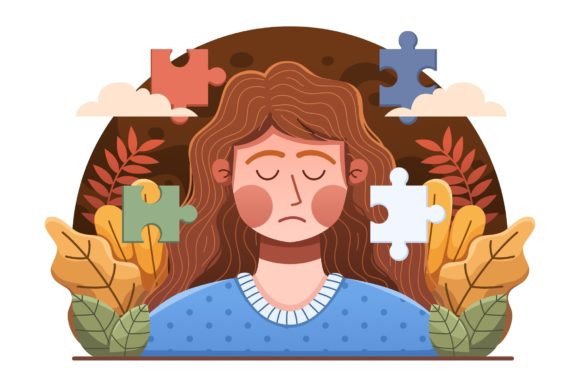
Imagine a vector illustration of a woman surrounded by puzzle pieces. A few pieces hover near her head, others linger around her chest, a couple rest in her open hands. This isn’t just art. It’s a mirror. The scattered elements represent the fractured thought patterns, the half-solved worries, and the way anxiety fragments a person’s sense of wholeness. Yet there’s intention in her posture—no panic, no collapse. She’s in the middle of the mess, but she’s also noticing it. That’s the awareness. And awareness, even when the complexity doesn’t vanish, is a quiet form of relief.
Making Sense of Fragmented Feelings Without Overintellectualizing
The real value of a metaphor like the puzzle woman is that it sidesteps jargon. Someone in the thick of a spiral rarely benefits from hearing “your amygdala is overactive.” They need something that mirrors their internal chaos without adding shame. Visual symbols do this beautifully. They say, “This is what it feels like, and you’re not broken for feeling it.” In support groups, a therapist might place a print of such an illustration on the table and simply ask, “Which piece are you holding right now?” The conversation that follows often touches territory that a questionnaire never could.
Complexity and awareness mental health work gains traction when we stop treating anxiety as a one-size puzzle. For some adults, the scattered pieces are financial pressures and caregiving duties. For others, it’s unresolved trauma, constant self-critique, or a culture that associates busyness with worth. The puzzle imagery adapts because the viewer projects their own mix onto it. A designer using this vector art on a clinic’s brochure isn’t just decorating. They’re offering a handhold for people who struggle to name what they feel.
Where the Rubber Hits the Road: Practical Encounters With the Metaphor
Picture a corporate wellness fair. The HR team wants to shift away from stale pamphlets about stress management. Instead, they print a large-format banner of the puzzle woman, with an invitation: “Which piece is weighing most today?” Employees scribble words on actual sticky notes—deadlines, imposter syndrome, sleepless nights—and attach them to the corresponding puzzle pieces. Suddenly, anxiety isn’t a taboo. It’s a collective, visually represented experience. The banner, originally a simple vector illustration, becomes a participatory installation.
Then there’s the digital side. A mental health advocate runs an Instagram campaign during Anxiety Awareness Month. They use the same illustration in carousel posts, each slide zooming into one puzzle piece with a caption about grounding techniques. The campaign’s engagement jumps because people see themselves in the artwork. The file format versatility here matters immensely. One day they need a crisp 4000 x 3000 px PNG with a transparent background for a story overlay. The next, they’re editing color hues directly in Affinity Designer V2 with the native AFDESIGN file. Another team member might open the AI or EPS version in Adobe Illustrator to adjust the puzzle piece arrangement for a billboard. Without multiple formats, that fluidity breaks.
Education environments also benefit. A university counseling center creates an infographic series about identifying anxiety symptoms. Each infographic features the puzzle woman graphic as a unifying visual anchor. The 100% vector nature of the file means they can scale it from a tiny mobile screen to a building-size projector slide without a pixel out of place. They export to SVG for their interactive web tool and flatten full-resolution JPGs for posters—all from the same purchased asset.
Why Different People Lean Into the Puzzle Metaphor Differently
- Mental health practitioners often use the illustration during intake sessions. A new client may find it easier to point at a puzzle piece than articulate “I feel fragmented.” The image becomes a conversation facilitator.
- Graphic designers and content creators working on awareness campaigns value the Complexity and Awareness Mental Health theme because it carries emotional weight without triggering graphic imagery. It’s safe for diverse audiences while still honest.
- Authors and publishers of self-help books might license the vector to use as a chapter opener or a workbook page. It visually breaks up dense text and gives the reader a moment of reflection.
- Social media managers for nonprofits love the PNG and JPG formats at 4000 x 3000 px because they can crop square or vertical without losing detail—critical for platforms that favor high-resolution, emotionally resonant visuals.
- Product designers for mental wellness journals or planners incorporate the graphic into cover designs or internal pages, knowing the Affinity Designer V2 compatibility means they can easily adapt the artwork to fit bleed areas and print specifications.
Before You Choose This Kind of Asset, a Few Real-World Considerations
Not every visual metaphor lands the same way across cultures. For some groups, puzzle pieces carry associations with autism awareness specifically, which can muddy the message if you’re strictly addressing anxiety. It’s worth checking the context of your audience. Localize the imagery if needed by adding or subtracting elements—something the layered vector structure allows, especially in AI or AFDESIGN formats.
Another nuance: the complexity itself can overwhelm. In a minimalist-leaning brand, the scattered puzzle pieces might feel too busy. However, using the graphic in a single-color monoline style or with reduced opacity often solves that. The 100% vector composition makes such tweaks painless. You can isolate the woman’s silhouette separate from the puzzle elements in a few clicks within Adobe Illustrator or Affinity Designer V2.
It’s also worth acknowledging that no illustration replaces human connection. The puzzle woman might spark recognition, but the real work of anxiety relief happens through support networks, therapy, and sometimes medication. The artwork is a bridge, not a destination.
When Complexity Meets Awareness, Self-Compassion Sounds Different
One of the quietest benefits of integrating complexity and awareness mental health into visual resources is the permission it gives to feel multiple things at once. Anxiety doesn’t erase love, ambition, or humor. A woman holding puzzle pieces can still be depicted with a soft smile, a look of determination, or even a tear. The vector illustration’s editable nature lets advocates tailor that expression to match the tone of their specific campaign—hope, resilience, or raw vulnerability.
Consider a podcast cover art scenario. The host, who interviews people about living with anxiety, needs a cover that feels personal and universal. The puzzle woman art, slightly recolored to match the podcast’s palette, becomes the anchor. The SVG format integrates smoothly with web platforms, the PDF version goes to the printer for promotional postcards, and the layered AFDESIGN file lets the designer animate individual puzzle pieces for a video intro later. That’s not just convenience; it’s creative momentum. Instead of spending hours redrawing, the team spends time refining the message.
Translating Awareness Into Environments That Actually Support People
Awareness alone often gets a bad rap. Slogans and ribbons have their place, but what changes the day-to-day experience for a person with anxiety is an environment that adjusts. A workplace that hangs an art print of the puzzle woman near the quiet room signals something subtle: “We see the mess, and we’ve made space for it.” A therapist’s telehealth background featuring the illustration sets an immediate tone—no pretense, no sterile detachment. Small signals accumulate.
The multiple format files become a practical superpower in these distributed efforts. A team might design a web banner in SVG for crisp loading, simultaneously print table tents from the 4000 x 3000 px JPG, and hand off the raw EPS to a promotional merchandise vendor for tote bags. The illustration moves across materials without degradation, carrying the same emotional nuance whether it’s embossed on a journal or pixelated on a screen at 72 dpi.
Holding the Pieces Together Without Forcing a Perfect Fit
There’s a risk in over-messaging. Too many puzzle pieces, and the metaphor becomes cliché. The sweet spot is restraint: the woman in the artwork doesn’t need to be solving the puzzle. Her strength lies in staying present with the incompleteness. When you use this asset in an infographic about anxiety relief strategies, it’s okay to leave some white space—literally and emotionally. Let the viewer fill in gaps with their own meaning.
Designers who dive into the native AFDESIGN or AI files often discover layered opportunities: maybe one puzzle piece gets swapped for a leaf, a word, or a heartbeat line, customizing the narrative without losing the core metaphor. Because the file is 100% vector and compatible with Affinity Designer V2 and Adobe Illustrator, that experimentation isn’t a technical headache.
What Lasts After the Post Scrolls By
Trends in mental health design shift, but the human need to externalize inner chaos remains constant. A well-crafted vector illustration outlasts any single campaign. When someone saves a social media post or pins a printable PDF to their board, they’re often grasping for a visual anchor that reminds them they aren’t alone. The puzzle woman, with her quiet complexity, can sit in a folder for months and still feel relevant on a hard day.
For anyone curating resources—whether a solo therapist, a marketing director, or a community organizer—having a single, cohesive visual with flexible formats simplifies continuity. The file list—AFDESIGN for Affinity Designer V2, AI, EPS 10, SVG, PDF, JPG 4000 x 3000 px, PNG 4000 x 3000 px—essentially future-proofs your use. Today’s project might ask for an editable EPS; next year’s might demand an SVG for a new app. The work doesn’t need to be remade. It adapts.
In the end, complexity and awareness mental health isn’t about dissecting every anxious thought. It’s about noticing the fragments with enough softness to let some of them rearrange on their own. And sometimes, that starts with an image of a woman who looks a lot like you or someone you love, standing in the middle of her pieces, not running from them.